
Finding wildlife volunteer projects in 2026
“Cease being intimidated by the argument that a right action is impossible because it does not yield maximum profits, or that a wrong action is to be condoned because it pays.”
― Aldo Leopold, “A Sand County Almanac” (1949)
Originally written for our members by our Program Manager, Jared Frasier
It is time for radical volunteering.
Demonstrated by our most successful members, radical volunteering builds the deepest community and most public good will.
It means showing up and doing the work that others cannot do or will not do and not being shy about it.
Radical means consistent.
Radical means not afraid of the mundane.
Radical means tackling the need, whatever and wherever it is.
Authenticity is earned by taking positive action.
Right now, taking positive action is seen as pretty darn radical… especially because (whether their legs are being cut out from under them or, in rarer cases, they have been shooting themselves in the foot) some conservation groups are struggling to meet the moment and fulfill their missions.
I speak with leaders from several causes every week, and what they are trying to navigate while remaining faithful to their missions is truly staggering. Funding cuts, staffing shortages, hostile politicians, and volunteer leaders terming out and burning out are really having a profound negative effect on the amount of work being done for wildlife at this time.
Choosing who to partner with this year will be critical to getting the most out of your volunteer efforts, and we get into the specifics of that towards the end of this module, but before that — I really want you to embrace a mindset of radical volunteering.
For both business and individuals:
I am seeing a couple strong radical volunteering themes from our most experienced and successful membership.
Consistently showing support for their favorite conservation groups by pushing information about the work those groups do out to their followers at a steady rate.
This is an at-minimum action that really builds culture and public good will. If you have social media, you have a share button. Use it. You don’t need to create a whole campaign to share posts — anymore, polished campaigns are seen as performative. The share button takes your ego and any “uncanny valley” brand perceptions out of the equation.
Partnering in low-skill administrative work is helping fill the current staffing / funding gaps.
I have spoken with multiple groups that are too short-staffed to accomplish all their office work and their missions, but do not know how to ask volunteers for help. Mundane but necessary tasks (reporting, compliance paperwork, program coordination, communication reviews, etc.) that used to be fulfilled by support staff and interns are now falling to the people who should be focused on tackling the programs that these organizations exist to accomplish. Add to this, the catastrophic drop-off in volunteer board engagement that has recently intensified, and you have wildly under-supported conservation specialists facing the possible shut down of their work, entirely. 2hrs a week in administrative support may not be a lot to you or a member of your team, but it could mean everything for one of your small, local conservation causes.
Warning: Calling up a stressed-out and overworked conservation group and asking if you can help them with administrative work might just get you invited to birthday parties and their kids’ school concerts. You will be loved.
Coordinating boots-on-the-ground projects and public advocacy campaigns with other volunteers on behalf of understaffed causes is keeping the needle moving forward for conservation.
This has always been popular work for our members and their friends or customers. But again, many of the new conservation group leaders do not know how to recruit help for it.
Having a business or group of friends call you up and ask, “Do you have any projects our team can tackle this year?” has an profound effect on morale for these groups, even if they do not immediately have anything available for you to do. If you know and believe in the group, do not be dissuaded if they do not have something for you to champion right away. Again, they are not used to the help, but a good group will find a way to plug you in. It just might take a week or two to build out an opportunity for you.
We love connecting people to opportunities like these, and we know some shortcuts to getting you engaged with as little front-loaded work as possible. Reach out if you would like some help: Contact Us
Prioritize volunteering that makes noise and resonates with your people.
“When you’re dead, you’re dead. But you’re not quite so dead if you contribute something.”
- John Dunsworth, from an interview on the set of ‘Trailer Park Boys’ (2017)
Right now, we need visible action for conservation.
If you have ever worked in emergency services, or watched medical shows, you know that there are two types of people during a crisis:
Those who gawk at the crisis unfolding and critique the situation, without actually stepping in to help.
Those who dive in and try help.
The wildlife conservation industry is in crisis.
As I already stated, the funding cuts, hostile politicians, and dramatic staffing upheaval have created an environment where the amount of work being accomplished has slowed to a trickle of what it once was in some places.
A lot of people and even some businesses have turned to burning their time online, gawking at and critiquing what is happening.
We are not going to gawk.
We are not going to critique.
We are going to help you act, with unimpeachable intent.
To make the largest impact during this time of crisis, your actions must be visible and public.
At a time where public engagement is being torn thousands of directions, publicly being a beacon of hearty support - no matter the volunteer work done - is just as important as actually doing the work.
It emboldens others to invest their time in positive action, following your lead.
Eventually, it turns the ship upright and around again.
For businesses:
Again, be selective about the volunteer projects you take on. Limiting yourselves to projects to your core passions ensures that your work is received as authentic by the two most important groups for your business’ health: Your team and the public.
Let’s take it a step further: Limit your volunteered time to causes that fit your core outdoor passions AND directly connect with the core outdoor passions of your customer base.
Our business members with the highest brand loyalty do this.
They also, not coincidentally, drive the most public support to the conservation work that they care about.
Many managers overcomplicate this — we have seen some overblown presentations built in the hopes of selling owners and investors on what is really a simple principle.
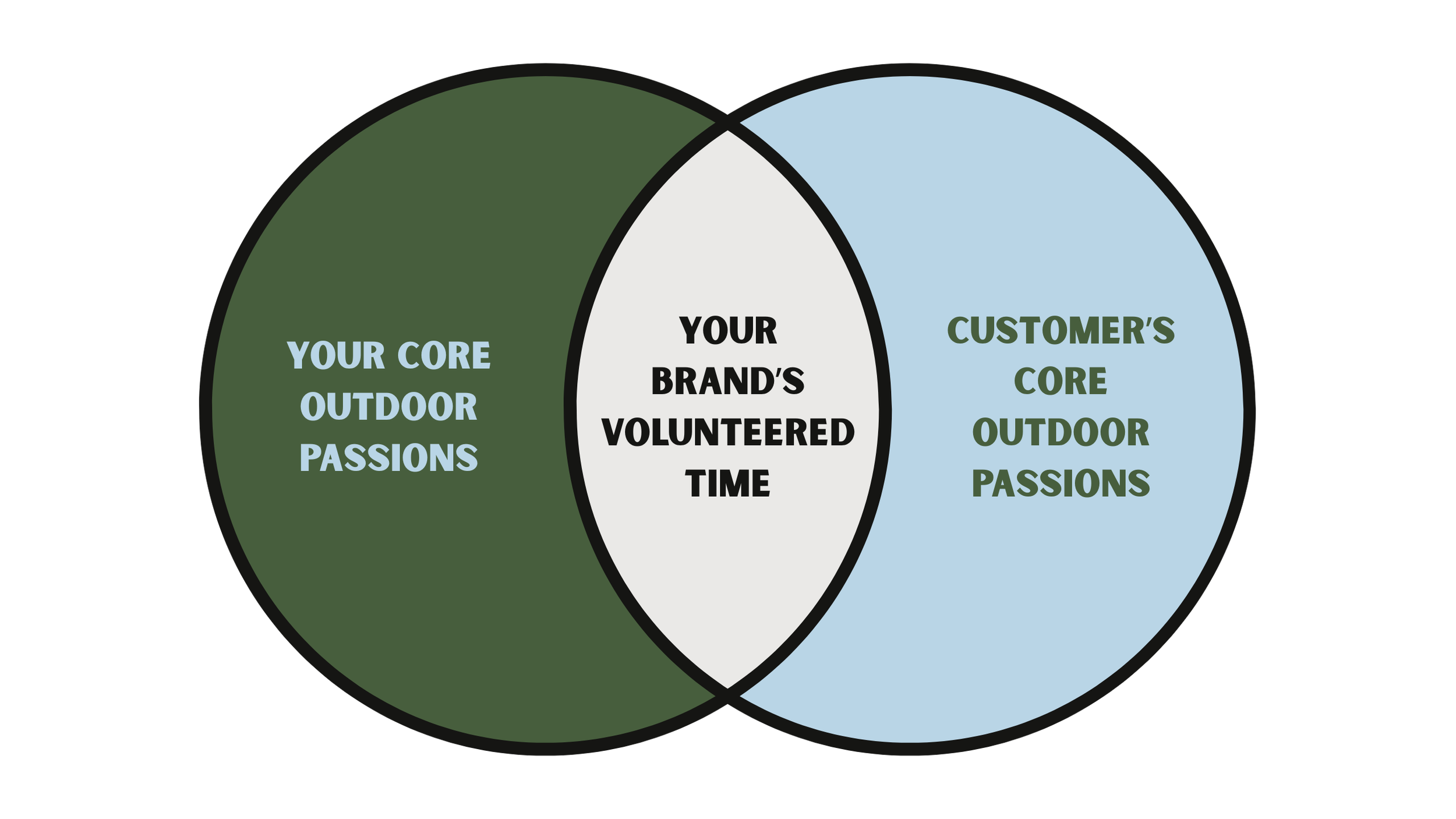
That’s it. Combine your core outdoor passions with those of your customer base and that is where you need to focus your volunteer time.
Unfortunately, instead of tackling local conservation projects that directly benefit their employees and local customer base, many go after large national coalition projects… and just get lost in the noise or the shadow of brands with huge marketing budgets. I’ve even seen it happen to billion-dollar brands.
Or worse, they spend all their volunteer time doing work that does not directly (or even tangentially) benefit their customer base.
The wrong way: Not long ago, I spoke with a company that makes ultra-light gear for backcountry hikers and climbers… but their only conservation volunteering was their leadership team doing a snorkel reef cleanup every year — over 1000 miles away!
The right way: Two of our local business members that make backcountry meals (Gastro Gnome Meals & Angry Pika Food Co.) volunteer their time on trail projects, alpine species conservation, and public access projects… things all their customers care about.
The wrong way: There was the hyper-regional home services company whose owner volunteered hundreds of hours of his time to lobby for conservation programming that mainly benefitted international hunters… but hardly any of his team or customers were hunters.
The right way: The owner of the first brewery we ever certified would volunteer his time to lobby for clean water at public meetings as a business owner who needed clean water to brew with… but also as a brewer whose customer base was largely, like him and his employees, anglers. That connection wasn’t really “on the nose”, but it really resonated with the community once they saw it.
That Venn diagram of core outdoor passion overlap is so simple, but so rarely followed.
Be the rare brand.
For individuals:
Take the best practices I laid out for our businesses and apply them for your personal life, but instead of considering customers, think about your personal sphere of influence: your family, friends, and community.
Your goal is replication through resonation.
Our most effective individual members are average people with “normal” day jobs, but absolutely infectious passion for conservation volunteering. Show your passion through your volunteering and people will want a piece of the action for their own lives.
What you spread is what you will grow.
Yes, is important to rally folks to fight against attacks on wildlife, ecosystems, and public lands. But, if all you tell your people is bad news that bad guys are doing bad things... for most people, you just become noise.
Regulating this can be hard, when the attacks are increasing in their frequency, brazenness, and stakes. But, a village constantly sitting on alert and preparing for war is quickly exhausted. Also, if you are doing this online, your following might quickly turn into an idealogical echo chamber of people who get loud online but do not show up in any other form of conservation advocacy.
The balance is different for everyone, but the most effective volunteers make a conscious and active effort to manage their volunteer time in such a way so as to both inspire but not exhaust their people whose passion does not yet match their own.
Prioritize non-profit partners by their real-world work capacity.
The current reality of the unprecedented funding cuts to conservation programs, and the tightening of belts that most of us are currently needing to engage in, is having a substantial shift in the program load of virtually every conservation group. Groups that used to be able to advertise dozens of habitat projects every summer might only have 4-5 available this year… if that.
Many local groups are pre-built with unique volunteer opportunities in their annual programming load. However those groups have liken taken a back-seat in the public eye over the last several years of heavy growth and advertising by national groups.
They are still doing their work, they are probably in your backyard, and they would love to partner with you.
Lucky for you, we have tracked what we are seeing through our members, through direct communications from the non-profit groups, and even the roll-calls lay-off / forced resignation announcements from state and federal wildlife and land agencies.
Consider these your volunteer project partner finding cheat sheets:
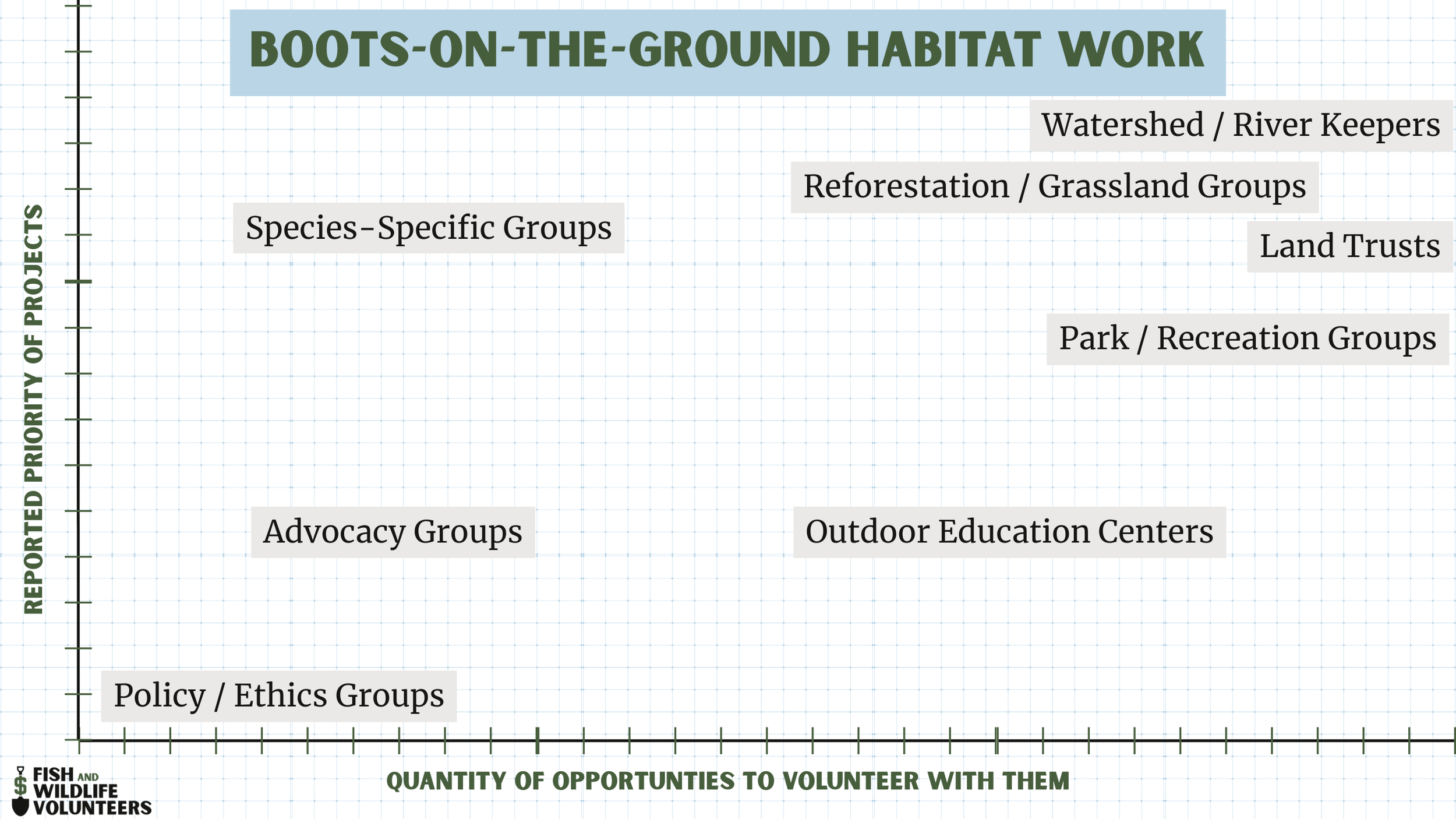
Watershed/river/water keepers, land trusts, and city/state/provincial/national park and recreation groups have nearly unlimited capacity for boots-on-the-ground habitat projects in a given year because they are typically the non-profit partners for government and private management of land and water resources. Even if agency staffing and budgets are in turmoil, they will likely have habitat work for you to do!
Reforestation / grassland groups and outdoor education centers have the next greatest quantity of opportunities to partner in habitat work for the same reasons as the first group, but both can be highly seasonal.
Species-specific groups and advocacy organizations do vital habitat work, but these opportunities are often limited by region and local staffing capacity. Regional chapters of these organizations often are the best place to find a way on to their habitat projects.
Policy lobbying and outdoor ethics groups rarely work on habitat projects. There is always an exception to that rule, but they excel and specialize in other areas.
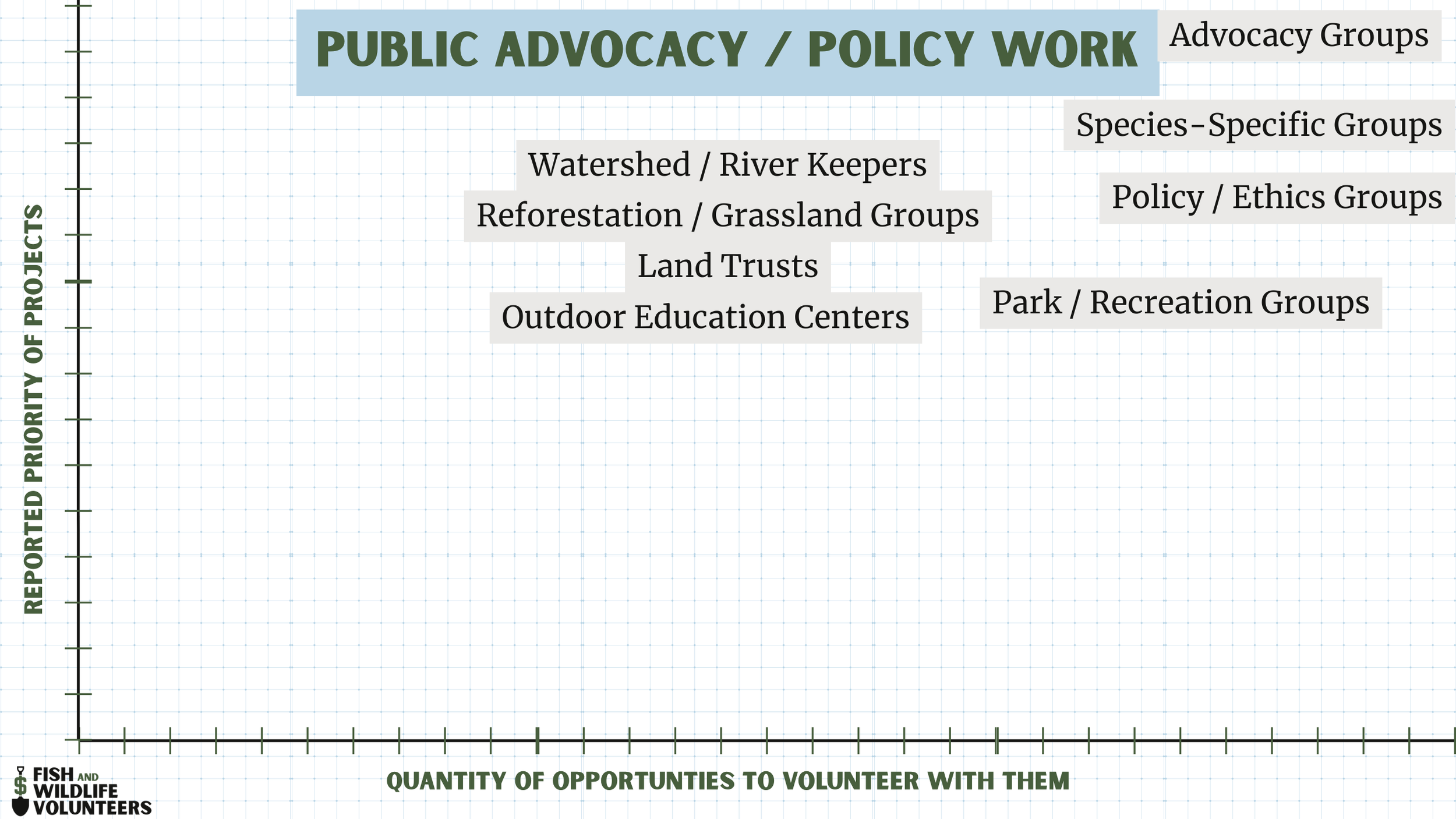
If you want to be a leader in public advocacy for conservation and building policy for wildlife and wild places, the advocacy groups, species-specific groups, and policy / ethics groups will always have the need for your volunteer efforts! Some non-profits will have more opportunities (and be open to input) than others, but these people are busy doing this work year-round. Just check to make sure that they are a 501(c)3, if you want to avoid directly supporting political campaigns. We are regularly helping our people and businesses with due diligence checks like that.
To a slightly lesser degree, because they are often directly tied to government agencies or land/water uses, park and recreation groups, also have a lot of volunteering opportunities for advocacy work. Look for “Friends of [place people like to recreate]” groups, as they often need year-round representation at public meetings.
Watershed/river/water keepers, reforestation/grassland groups, land trusts, and outdoor education centers also need your advocacy and support around policy, but it is usually limited to community affinity campaigns, local resource meetings, and seasonal community engagement opportunities. That said, when these folks throw up a flare for help, they need your support.
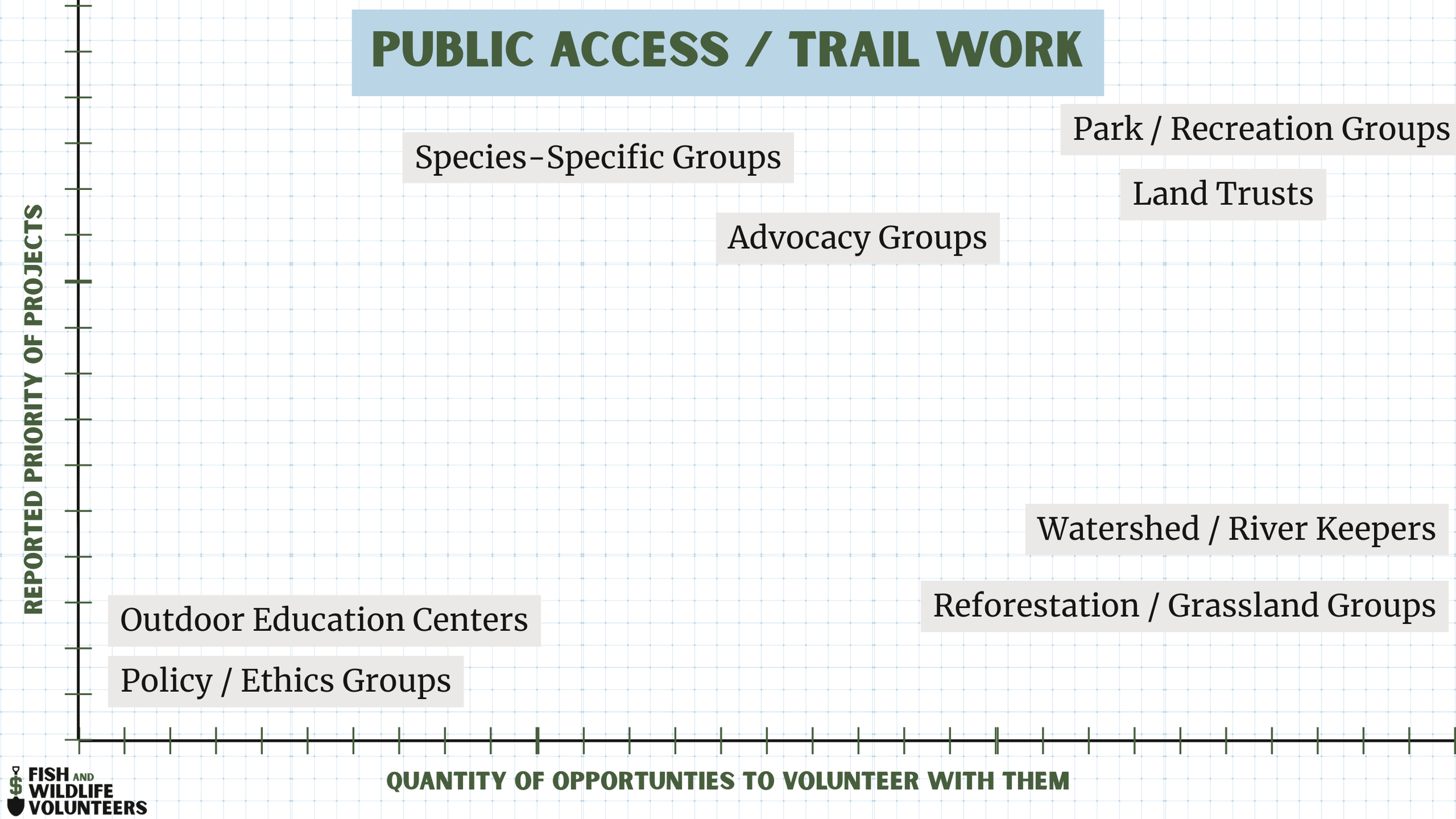
City/state/provincial/national park and recreation groups, land trusts, watershed/river/water keepers, and reforestation / grassland groups almost never run out of opportunities to volunteer on public access and trail work projects. The water/river/grassland folks just do not advertise these opportunities as much as the other two categories do. Odds are, if you have access to any land or water in your area, these are the groups partnering with government and private entities to make that happen. Their work is so vital for maintaining public access that, on multiple occasions, we have helped people start their own if one of these didn’t exist for them in their area.
Advocacy and species-specific groups have slightly fewer access and trail maintenance projects, but they do engage in them. Species groups in particular advertise a lot about their access work for the habitat areas their specific wildlife species are, but opportunities to engage in these projects are highly regional and seasonal. Always check with a local chapter of an advocacy or species-specific group for a chance to join these projects.
Outdoor education centers and policy / ethics groups rarely have public access and trail work projects to partner in. Again, there are exceptions, but this is not what they specialize in.
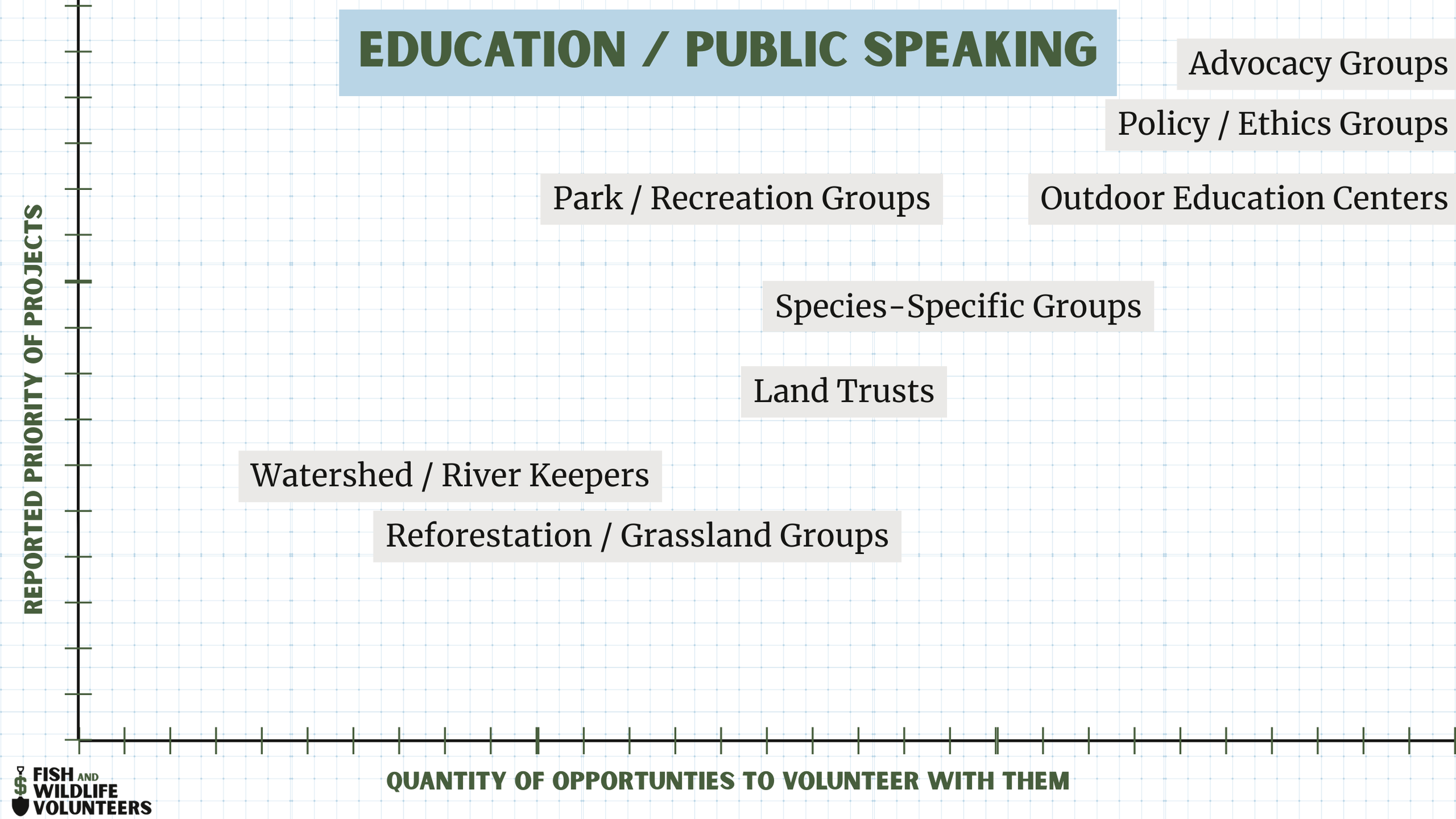
If you want to help educate the public about conservation, look to the advocacy groups, policy/ethics groups, and outdoor education centers for nearly unlimited opportunities to engage — even if you are not a professional in the space. These groups specialize in communicating complicated topics in an inspiring way and are always looking for fresh faces and clear voices to help with the work. Make sure you have a good webcam, dependable microphone and good lighting for helping with their regular webinars!
Park/recreation groups, species-specific groups, and land trusts have slightly less capacity for lay-persons to volunteer as educators and public speakers, as those needs can require hyper-specialization. That said, they often greatly benefit from story-tellers to help inspire public support and donors. A great partnership opportunity is helping host storytelling nights or online series with them to help raise funds or support for a project they are working on.
Watershed/river/water keepers and reforestation/grassland groups often require an even higher level of expertise from their educators and speakers. But the storytelling role still exists, though, and is worth pursuing if it is in your wheel house.
We exist to help you!
This stage of your volunteer planning can be a lot of work — even for one person, but especially for large businesses.
We would love to help you accomplish your conservation volunteering goals: Contact Us